INTRO TO THE MODERN AGE PART 2
_______________________________
HOW MY TIMELINE IS STRUCTURED

The Unauthorized Chronology of the DC Universe by Chris J Miller (2001-2010)
Much of the information in the Modern Age section of the Batman Chronology Project was directly influenced by the unbelievably amazing “Unauthorized Chronology of the DC Universe” by Chris J Miller. The domain registration on Miller’s site, originally at dcu.smartmemes.com, has lapsed, but you can still check out his unfinished but inspirational historiography via the Internet Archive’s Wayback Machine. If you haven’t seen this site, then you aren’t a true continuity buff or worthy of the title “comic book nerd.” I encourage everyone to check out this herculean effort! Like me, Miller regards the canonical narrative as it is written (post-retcons, of course). His timeline also mirrors mine in length, around twenty-three years, based on information taken directly from comic books. If you literally read every Modern Age Batman comic book from 1986 through 2011, noting all the changes of season, topical references, references to time, editorial notes, character aging, and character development, you wind up with a mix of contradictions. But if you whittle that down to form the best possible combination of these contradictions, you’ll be able to find a (semi-)concrete timeline. This is essentially what Miller and I both have done.
However, I’d be remiss if I didn’t explain why my chronology explicitly (and purposefully) differs from other chronologies on the web, including Miller’s “Unauthorized Chronology.” First off, when you add-in all the other DC characters (besides the Bat-Family) you’ll find that things need to shift and fit-to-form even more in order to make things understandable and explicable from a narrative perspective. This is Miller’s burden, one which I haven’t quite undertaken—and one that has caused some contradiction between our works. Miller’s chronology, along with some other respected online timeline projects, also places important events (such as the debut of Two-Face, the appearance of Dick Grayson as Robin, and the formation of the JLA) a year or so prior to when they appear on my list. For example, Miller has Two-Face debuting in Year Two and Robin debuting in Year Three shortly after the JLA. My chronology lists Two-Face debuting in Year Three and Robin debuting in Year Five before the JLA debuts.

Batman: The Long Halloween by Jeph Loeb & Tim Sale (1996-1997)
The Batman Chronology Project mainly differs because it does not compress, shorten, or exclude The Long Halloween or Dark Victory. The Long Halloween is the ultimate and final origin story for Two-Face. Likewise, its sequel, Dark Victory, is the ultimate and final origin story for Robin. (Robin: Year One was published a year after Dark Victory, but it actually takes place after Robin’s debut in Dark Victory, co-existing alongside it fairly well.) The only way to have Two-Face debut in Year Two is to retcon the Long Halloween into a shorter version. The only way to have Robin debut in Year Three is to basically chisel the entirety of the yearlong Dark Victory series into mere weeks. And the only way to have the JLA debut in Year Three is to have already eliminated the three years necessary to house The Long Halloween and Dark Victory. Furthermore, one would probably need to eliminate many of the Legends of the Dark Knight stories that I refuse to exclude from my timeline to get to a universe where Two-Face, Robin, and the JLA debut earlier.
One could argue that compromise (retconning/time-compression) is necessary to jibe with DC editorial and these other Modern Age timelines, especially since the Batman Chronology Project time-compresses many arcs in Modern Age Batman’s later years, especially after Year 14. I am against that argument, however, because the temporal tightening that occurs toward the latter end of the timeline doesn’t alter the narrative or change in-story details (except in quite rare, unavoidable cases). The majority of time-compression happens simply via the elimination of gaps and ellipses (i.e. breathing room) in between stories. Most topical references have to be ignored as a result of this compression, but narrative isn’t erased or changed wholesale.
Another reason to avoid retconning/shortening The Long Halloween and Dark Victory is that these titles are limited series set in Batman’s past. Written and published with 20/20 hindsight, they are retroactively fitted into the timeline AS OPPOSED TO already being in existence on the timeline and then retroactively changed. Stories like The Long Halloween and Dark Victory mirror Frank Miller’s “Year One” in that they are not malleable and operate with specificity. At the opposite end of the spectrum from these limited-series-as-flashbacks are the average ongoing monthly issues, which are more prone to time-compression and retcons due to the tricky nature of long-form serialized storytelling by multiple creators. Monthlies tend to contradict other monthlies because there are a ton of different creators and editors working hand-in-hand to build an entire multiverse in relative real-time. This makes it so that the contradictory-prone monthlies can only align correctly (or be aligned correctly) by retconning their narratives to fit neatly into a timeline—but only after one can gather all the pertinent puzzle pieces of the universal line, which means only after a lengthy time has passed since initial publication.
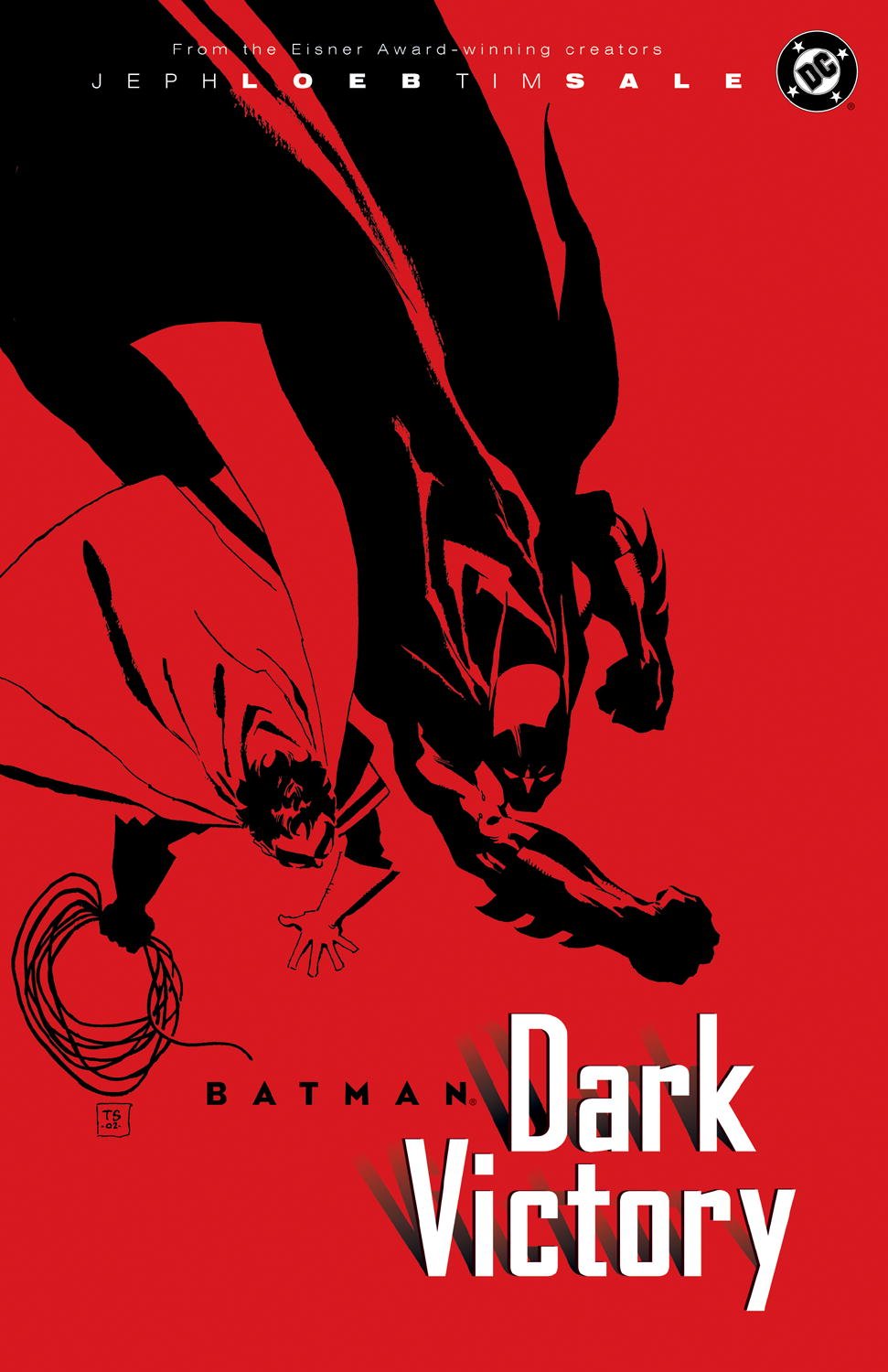
Batman: Dark Victory by Jeph Loeb & Tim Sale (1999-2000)
I can’t speak for the various opposing chronologies out there, nor can I speak for DC itself, but I can quote from Miller’s website notes to explain his mindset, which surely reflects the mindsets of those who disagree with my opinions. By laying out Miller’s timeline-building blueprint, I can compare and contrast my own architecture with his, which gives a clearer overall idea of why our timelines don’t sync up. To start, Miller puts the debut of Two-Face and the first appearance of Robin earlier in order to match his timeline as closely as possible to what DC probably had in mind. He also gives credence to Batman Annual #14 (entitled “Eye of the Beholder”) as the legit origin of Two-Face, and to “Batman: Year Three” flashbacks (from Batman #437) as the legit origin of Dick becoming Robin. To quote Miller: “Superficial differences (in dialogue, etc.) notwithstanding, a close look at the details reveals that The Long Halloween story is clearly meant to expand upon the [shorter] Batman Annual #14, not supersede it. However, note that the internal timeline of Long Halloween cannot be fully reconciled with other known events, as it would delay Two-Face’s debut until late Year Three—while its sequel, Batman: Dark Victory, would push Robin’s debut all the way to Year Five.”
While Miller—and a lot of other folks—believe that both stories co-exist as they were originally published (with little or no alteration), that is just not possible. While the opening part of Batman Annual #14 (the Rudolph Klemper bit) has been canonized via Matthew Manning’s The Batman Files, occurring immediately before the start of The Long Halloween, The Long Halloween IS meant to supersede Batman Annual #14, which means, as Miller fears, Two-Face’s debut is indeed pushed back to Year Three. Likewise, Miller laments that, if The Long Halloween is to be taken as unaltered gospel (which is how I have basically taken it), Robin’s debut is pushed back to Year Five. On my timeline, Robin’s debut does indeed occur in Year Five.
Miller goes even further in relation to Dark Victory. His caveat: “If most of the [Dark Victory]’s specific holiday references are disregarded, and the crimes depicted are read as merely holiday-themed, the timeframe can be compressed.” Because of this sentiment, Miller retcons Dark Victory from a full year to a few weeks, making it so that the Hangman (Sofia Falcone Gigante) doesn’t kill on holidays but is merely a holiday-themed killer. This is a huge liberty Miller takes to make his timeline work—one I am unwilling to take.
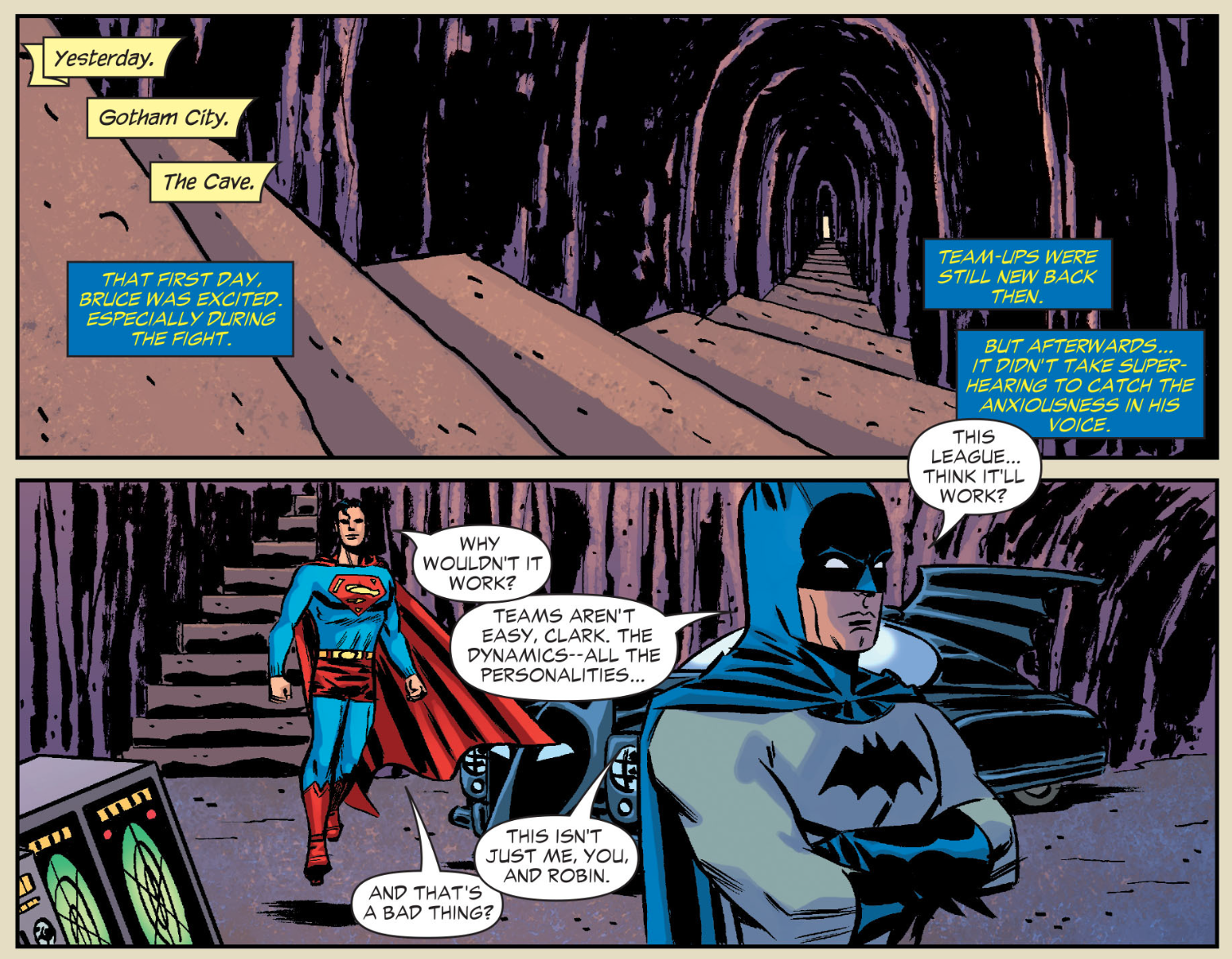
Justice League of America Vol. 2 #0 by Brad Meltzer, Eric Wight, & Alex Sinclair (2006)
Concerning Miller’s early placement of the JLA debut, it would seem that he regards JLA: Year One as canon primarily because the “origin” piece in the second feature to 52 #51 shows a flashback to JLA: Year One, specifically an image of Batman, Superman, Wonder Woman, Aquaman, Green Lantern, Martian Manhunter, Flash, and Black Canary fighting the Appelaxians. This “JLA origin” also says that the founding trio doesn’t join full-time until later. Miller’s timeline canonizes both JLA: Year One and a seminal flashback scene from Justice League of America Vol. 2 #0, which is fine. However, I take issue with Miller’s following rationalization: “[The JLofA v.2 #0 flashback scene depicting the Big Three forming the JLA] is a notable change to ‘New Earth’ history as compared to post-Crisis canon. The relevant flashback scene seems to take place in the immediate aftermath of the founding battle with the Appellaxians, but a reference to Robin precludes a date earlier than that. The origin recap in [the second feature to] 52 #51 confirms the delay as well.” While a “delay” it does indeed confirm, we are not specifically told that the delay is a full-year delay due to JLA: Year One. In fact, I’d argue against that, especially since JLA: Year One‘s narrative doesn’t even span a full calendar year. Also, the flashback from JLofA Vol. 2 #0 clearly reads as if it occurs very shortly after the Appelaxian affair (rather than a full year or even months later). The reference to Robin in JLofA Vol. 2 #0 solidifies the idea that the Appelaxian affair has to happen after the Boy Wonder’s official debut (and after he has met Superman). This fact is not reflected in Miller’s chronology, which runs counter to the simplest answer by placing Robin’s debut after the Appelaxian attack.
In summation, Miller’s chronology significantly alters both The Long Halloween and Dark Victory by mega-compressing them both into extremely shortened versions—and, in the case of the latter, nearly erasing it entirely. Miller also views the formation of the JLA differently, misinterpreting flashbacks and references related to it. But Miller isn’t alone. There are plenty of scholars and comics journalists who have followed his path. How can various timelines be so perfect (tooting my own horn here, sorry) and yet so opposing? It’s frustrating, but it boils down to a simple difference of opinion. My take dictates the direction and scope of my chronology while giving it validity. Could I be wrong? Like I always say, there’s no real answer. Luckily, aside from these three key areas—the Two-Face, Robin, and JLA debuts—the Batman Chronology Project links up pretty squarely with most other timelines, including Miller’s, in every other way.
___________________
________________________________________________________________________
DC’s BROKEN TIMELINE?
We’ve now discussed how my Modern Age timeline might differ from other credible fan-made timelines online, including Miller’s, but—and I’ll be the first to admit this—my timeline also differs from some of DC’s “official” versions of history. Many will instantly respond—if DC has an “official” Modern Age timeline or timelines, shouldn’t we bow down to one of them as canon? Those asking this question should keep in mind that even DC’s “official” versions of things, like my chronology, must be created or fabricated. The reason why I keep putting quotes around the word “official” is that there really can be no definitive history that can be taken as gospel, especially since any chronology must constantly shift to meet the never-aging lineaments attributed to the characters within its fiction. And the reason I say that DC has multiple “official” timelines is that different creators have counted the years very differently. You’d be hard-pressed to find two DC writers adhering to the same timeline, even under the company’s supposedly strict editorial umbrella. Thus, we get a complicated multiplication of chimeras.
Before addressing our differences, it’s worth parsing out what a few of DC’s “official” timelines might look like (and why these contradictory perspectives exist, again, within what is supposed to be a single shared sandbox).
First, according to Jeph Loeb (in a 2026 interview), DC didn’t even formally canonize Long Halloween and Dark Victory until 2008, so, before then, some editors and writers were factoring these arcs into their calculus, while others weren’t. Similarly, because DC was publicly mum on the status of Long Halloween and Dark Victory for so long, some parts of the fandom/readership considered these arcs canon from the get-go, while others didn’t. If you were in the camp that initially ignored Long Halloween and Dark Victory, it would have been unnecessary to question whether to do a strict (i.e. literal) reading of these arcs. Or to add extra years to the timeline because of these arcs. (At least, not until 2008, anyway.) Of course, as detailed above, Long Halloween and Dark Victory have unwaveringly been key ingredients on my timeline right out of the gate.
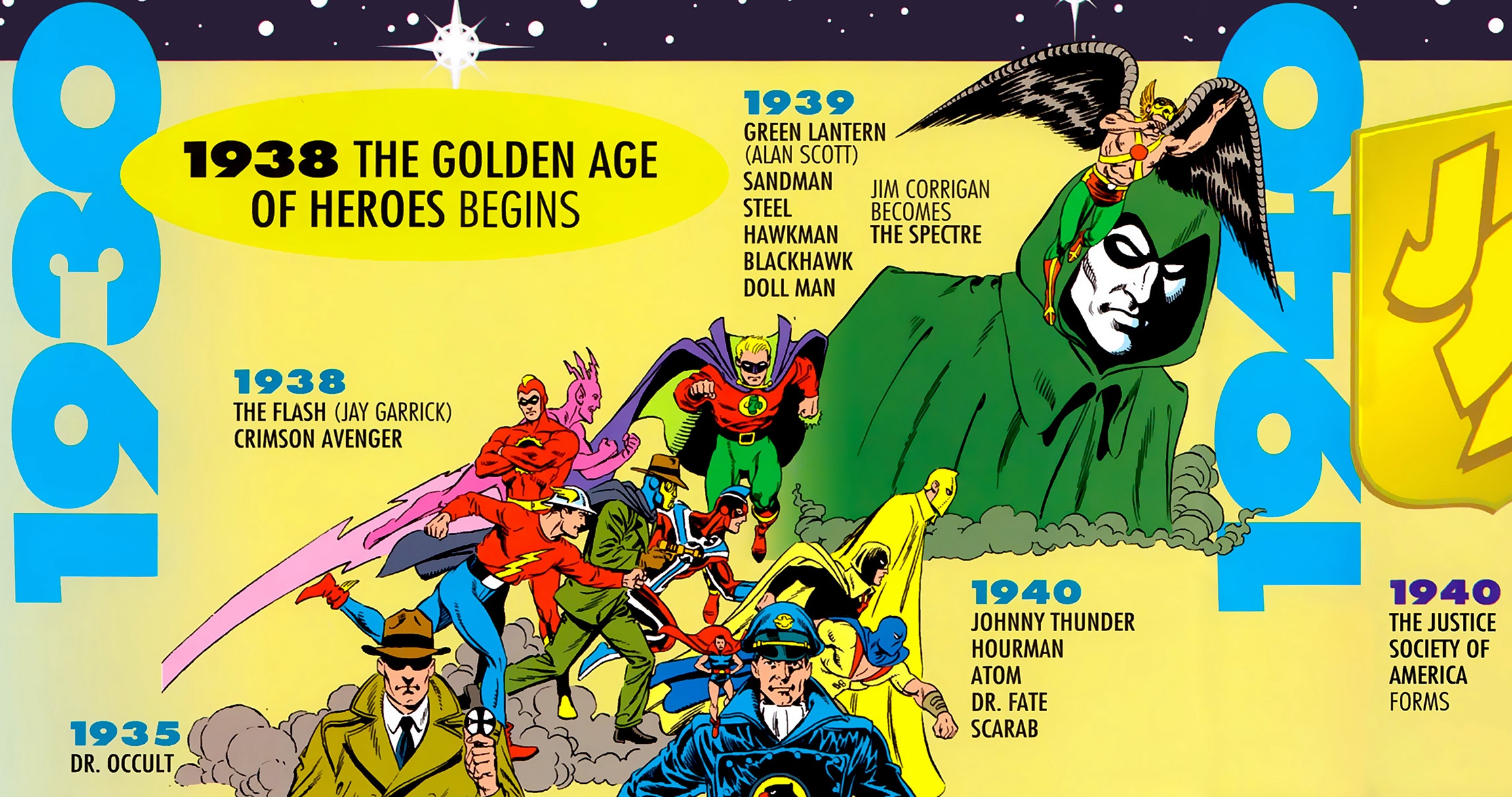
Zero Hour Timeline by Dan Jurgens (1994)
Second, sliding-time and retroactive compression can’t be denied when building any Modern Age timeline, but there is an argument as to how compressed the timeline should be. DC publishers have needlessly over-shrunk, compressed to a fault, and it has a lot to do with their interpretation of Zero Hour. Most DC higher-ups have considered the Modern Age timeline to consist of two separate continuities: a “pre-Zero Hour timeline” and a pre-Flashpoint timeline.” With this in mind, earlier stories noticeably shift from beefy, overstuffed texts into flattened reference materials. Anything pre-Zero Hour not only loses substance but also gets divorced into the distant void of its own autonomous chronology. In turn, the timeline gets significantly shortened because its meat-and-potatoes begins in 1994 instead of 1986. Of course, while DC execs typically leaned into the idea that Zero Hour was a hard reboot, some Modern Age creators went the other direction, viewing Zero Hour as a soft reboot (as I have), which sparked dissent and timeline breakage. Either way, it’s apparent that DC’s varied timelines are way more compressed than mine—they are hyper-compressed.
Robin Vol. 2 #116 by Jon Lewis, Pete Woods, Andrew Pepoy, & Noelle Giddings (2003)
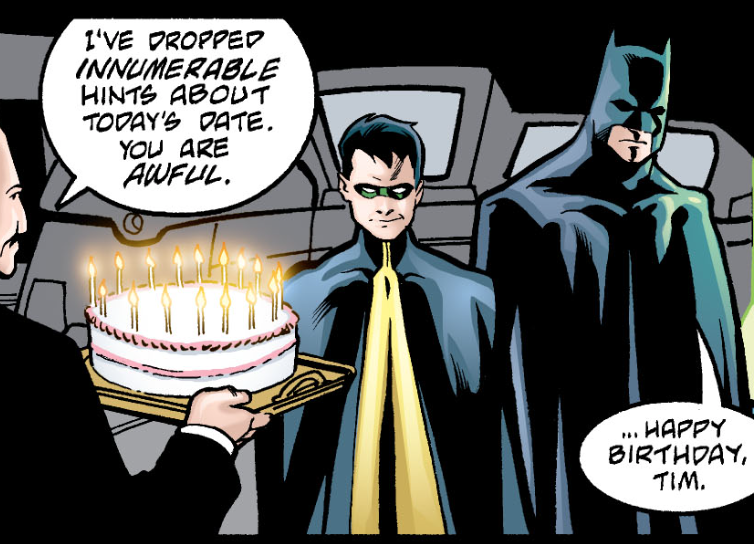
Because some editors and writers set Zero Hour as the full starting point for the Modern Age proper, character ages in many comics don’t jibe with my timeline, requiring fanwanks and caveats. A big example of this is Tim Drake, who debuts as Robin a bit younger than he does in the comics. If we hearken back to the tail end of the Golden Age and the bulk of the Silver/Bronze Age, DC publishers started to contradict their own timeline for fear that their characters were getting too old or stagnant. The same thing happens in the late Modern Age, where you started getting a proliferation of editorial tags and bogus time references—an attempt to stave off the eventual need to hit the restart button. The Modern Age DCU chugged along in relative real-time for about fifteen to twenty years and then—all of a sudden—time seemed to stand still (even though events kept on happening and characters kept on living their complicated little lives). When I constructed my timeline, I did so moving forward, building a correct chronological listing of stories. To create the timelines that DC seems to utilize, we almost have to work backward, looking at the latest possible references to ages (i.e. how old did DC say their characters were at the bitter end of the Modern Age) and how many “years ago” flashbacks in the later issues imply. These are the final clues in the Modern Age that tell us roughly how many years the Caped Crusader has been crusading.
Let’s take a look at some of these final clues. Even as we try to grip onto the veracity of these late-era references, the contradictions will be blatant—due in part to years of head-butting between creators and editors.
According to DC, by 2011, Tim is 17-years-old, going on 18 (as per Red Robin), Bruce is possibly nearing forty-years-old (said to be in his thirties in Batman RIP), and Bruce met Silver St Cloud nearly ten years prior (using Kevin Smith’s Widening Gyre as a reference, even though it’s non-canon). These tidbits—and more that I haven’t mentioned—give us a pretty decent idea that, according to most people at DC, Batman was around his 15th year in costume by the end of the Modern Age. Yet, as site contributor Amelie points out, Scott Snyder’s 2011 “Black Mirror” arc, which also takes place in 2011, clearly shows an adult James Gordon Jr, who must be at least 18-years-old (if not older). Since James Jr was born in October of Frank Miller’s sacrosanct “Year One,” this means, according to Snyder, Batman must be at least 19-years-old by 2011! And other minor examples seem to lean this way, too. Notably, in DC Universe Legacies, which admittedly contains a multitude of errors, writer Len Wein implies that Superman’s death occurs roughly seventeen or eighteen years after Wonder Woman’s debut! This is a rare instance from DC that points to a longer timeline, possibly as long as mine (i.e. 22 or 23 years by 2011). So, while clearly not everyone at DC is hellbent on über compression, it really muddies things further to have staff on completely different pages.
Below is a quick list of the fifteen-year timeline that a large group of creators (again, not all) seemed to have been cribbing from throughout (and especially towards the end of) the Modern Age. I will refer to my chronological listings as BY1 for Bat Year One, BY2 for Bat Year Two, etc…___________________
DC YEAR ONE: Frank Miller’s “Year One” still holds. Thankfully, the horrible addition of Batman peeing his pants (thanks, Kevin Smith) isn’t canon. Therefore, DC Y1 is almost the same as my BY1.
DC YEAR TWO: As site contributor/fellow Batmanologist Valheru states, DC Y2 comprises many stories referenced from the Kane/Finger era (i.e origins of most of Batman’s rogues gallery). The Long Halloween and “Batman: Year Two” go here. BY2 through BY3 is comprised mostly of these rogues gallery debuts and LOTDK tales. Many of the LOTDK stories aren’t canon anymore, according to DC. (Or if they are, they are compressed into near oblivion and all placed into DC Y2.) My BY2 is basically the same as DC Y2, also including “Batman: Year Two” and the start of The Long Halloween.
DC YEAR THREE: Dark Victory and “Venom” occur. Dick Grayson debuts as Robin at age 13. The JLA debuts here. (Timelines in Zero Hour, Batman Secret Files and Origins, Villains Secret Files and Origins, Nightwing Secret Files and Origins, and Guide to the DCU 2000 all list Dick debuting as Robin in DC Y3.) DC Y3 is basically my BY3 through BY6.
DC YEAR FOUR: This year comprises many Batman and Robin stories referenced from the late Golden Age (think “pop-crime”). DC Y4 comprises large chunks of my BY6 and BY7, which contain story references mostly from 1960 through 1967. It’s possible Silver St. Cloud debuts here in DC Y4. Kevin Smith’s storylines in 2010-2011 (from Widening Gyre) indicate that Bruce has known Silver for roughly ten years, which provides a reference point for the placement of her debut. Even though Widening Gyre is non-canon, at the very least, it shows us the mindset of DC publishers towards the end of the Modern Age. If we choose to ignore Smith’s storyline references because they are non-canon, then we can move Silver’s debut to DC Y7.
DC YEAR FIVE: This year comprises Batman and Robin stories from the late Golden Age (early to mid-1960s), but also marks the transition into the Silver Age (coinciding with Batman’s switch to the yellow oval costume). Batman’s Black Casebook (as gleaned from Batman #678) tells us that, by “5 years into the mission,” the majority of Golden Age tales have already taken place. DC Y5 is basically more of my BY7 (roughly 1964 to 1967).
DC YEAR SIX: More Batman and Robin stories referenced from the Silver Age into the very beginning of the Bronze Age. Pretty much all of my BY8 fits here, comprising of references from 1968 through 1972.
DC YEAR SEVEN: This is the “Penthouse” year. Bronze Age stories galore. Dick goes to college with a very early enrollment. The Saga of Ra’s al Ghul occurs. Damian is conceived. As site contributor Aidan K notes, on the DC timeline, there must be the assumption of accelerated aging for Damian, as he is conceived during DC Y7 and is ten-years-old during DC Y13. This is my BY9, comprising references from 1973 to 1981.
DC YEAR EIGHT: Dick turns 18-years-old and becomes Nightwing. Nightwing Vol. 2 #132-137 (“321 Days”) implies that Dick turns 18 this year. Jason becomes Robin at age 13 (going on 14). The Crisis on Infinite Earths occurs. Teen Titans Vol. 3 #42 tells us that Kid Devil is 12-years-old during Crisis and 17-years-old in during “One Year Later,” which jibes. This is my BY10, comprising references from 1982 to 1986. Site contributor Zilch notes an important reference from Len Wein’s DC Universe Legacies. While problematic in many areas, the series gives a good range to the age of the Modern Age DCU, with Paul Lincoln’s daughter, Diana, born at the start of the Modern Age. In the issue detailing the original Crisis, Diana is somewhere between a pre-teen and a teen, meaning that Batman and Superman have been around for 8 to 12 years by the time of the Crisis. There’s a slight implication in DC Universe Legacies that the Crisis occurs in DC Y10, but that would unfortunately squeeze Jason’s death, Babs’ paralysis, and some other stuff into an uncomfortably compressed DC Y10. This is up to the reader, but, despite the implication in DC Universe Legacies, DC still likely meant for the Crisis to go in DC Y8.
DC YEAR NINE: Barbara is paralyzed by Joker in Killing Joke. Jason is killed by Joker in Death in the Family. Tim becomes Robin at age 13. This is my early BY12. (Timelines in Batman Secret Files and Origins, Villains Secret Files and Origins, Nightwing Secret Files and Origins, and Guide to the DCU 2000 all list Tim debuting as Robin in DC Y9.)
DC YEAR TEN: Zero Hour, “Knightfall,” and “The Death and Return of Superman” occur immediately afterward, followed by “Cataclysm” and “Road to No Man’s Land.” My BY12 through early BY16 are wildly compressed into a single DC year. As mentioned above, in DCU Legacies, Wein implies that Superman’s death occurs roughly seventeen or eighteen years after Wonder Woman’s debut, which completely flies in the face of this 15-year timeline.
DC YEAR ELEVEN: “No Man’s Land” takes place this year. (In LOTDK #125, Gordon even says Batman has been around for ten years.) The rest of my BY16 syncs up pretty well with this year.
DC YEAR TWELVE: Our Worlds At War followed immediately by “Bruce Wayne: Murderer” and “Bruce Wayne: Fugitive,” and then “Hush,” JLA: Obsidian Age, Superman/Batman: Public Enemies, Death and the Maidens, “War Games,” The OMAC Project, “Under the Hood,” and Infinite Crisis. 52 begins. DC Y12 is my BY17, BY18, BY19, and BY20 all squashed into one single year. Judd Winick’s Batman Annual #26 implies that at least three-and-a-half years pass between Jason’s death and “Hush,” which jibes. Jason also turns 18-years-old in Detective Comics #790.
DC YEAR THIRTEEN: 52 concludes. “One Year Later” occurs. Countdown occurs. Grant Morrison’s run begins with Batman and Son, followed by Resurrection of Ra’s al Ghul, Trinity, Batman RIP, and Final Crisis. DC Y13 comprises all of BY21 and the first third of my BY22. Jezebel Jet mentions Bruce is “over thirty-years-old” (i.e. guesses he is “in his thirties”). It has been mentioned above, but bears a reminder that Damian debuts in Batman and Son at age ten. This means, as DC does with the short New 52 timeline, Damian’s aging process is artificially sped up. He would only have been in existence for about five or six years at this point, and yet he’s ten-years-old.
DC YEAR FOURTEEN: Battle for the Cowl starts this year. This is the rest of my BY22 leading up to Batman and Robin and the start of Red Robin. In Red Robin #25, Tim is still seventeen-years-old but about to turn eighteen.
DC YEAR FIFTEEN: Batman and Robin and Red Robin continue. The Return of Bruce Wayne and Batman Incorporated occur. Flashpoint happens at the end of this year. Paul Dini’s “House of Hush,” which also takes place this year, strongly implies that Bruce is nearing 35-years-old. This is my BY23. Don’t forget, Snyder includes James Gordon Jr in this year, going against the grain of the fifteen-year timeline. His “Black Mirror” arc clearly shows that 2011 is at least DC 19. This seems to jibe with Wein’s viewpoint as well.
There you have it. This fifteen-year timeline aligns with much of what DC published in the Modern Age and seems to be the historical foundation for many Modern Age Batman stories. Of course, as we’ve shown, Snyder was operating with at least a nineteen-year timeline, and Wein was potentially operating with an even longer one. It’s possible that Snyder and Wein were on the same page, and it’s even possible that their vision of the timeline was exactly like mine—a twenty-three-year timeline by 2011. In any case, it’s interesting to compare the compressed fifteen-year timeline with the albeit still highly compressed, dense, and detailed twenty-three-year chronology I’ve built. Don’t get me wrong, I appreciate the simplistic functionality of a fifteen-year timeline, but it really does relegate everything pre-Zero Hour to altered reference material. And, if you look at how top-heavy things are toward the backend, it even seems like it might similarly regard Infinite Crisis, essentially treating it as a hard reboot that wipes out everything before creating a new timeline loosely based upon seventy years of stories that took place before it. (To my knowledge, no one at DC has officially acknowledged Infinite Crisis as a hard reboot the way they have with Zero Hour, but it certainly looks that way when you examine their fifteen-year timeline with more scrutiny.)[1][2][3]
___________________
________________________________________________________________________
HOW TO USE THE BATMAN CHRONOLOGY PROJECT

Art by Shannon Wheeler (2012)
One final note on how best to use my chronology as a reading guide. It’s probably much more enjoyable not to break up story arcs and read them exactly as my timeline lists things. Rather, it is probably more enjoyable to read arcs as they were published or collected as trade paperbacks (i.e. as complete stories). If you are reading everything for the first time, I’d use my chronology as a basic framework to crib from. For instance, there’s no better place to begin in the Modern Age than with Frank Miller’s “Year One.” Maybe “Shaman” can follow afterward. For those who are already quite familiar with the texts and have read most of the narrative, it might be an interesting exercise to go back and read things in the exact order of my chronology. But as a first pass, I wouldn’t recommend it. I’d be lying if I said it wasn’t an endeavor to read superhero comics in “correct” chronological order, but, even so, it can be a really fun endeavor, should you choose to engage.[4][5]
_______________________________
____________________________________________________________________________________________
_______________________________
INTRO TO THE MODERN AGE PART 1 <<<< | >>> EARLY YEARS >>>
- [1]VALHERU: That fifteen-year DC version timeline really looks funky, doesn’t it? The Silver and Bronze Ages are basically Y5-8; the “Early Period” (aka Dark Age, or whatever you want to call the post-Crisis/pre-Modern Age) is Y9-11; and 2001 through 2011 is roughly Y12-14. So, basically, Batman’s first fifty years of publication are six years (excluding Miller and Loeb’s artificial Y1 and Y2), and the last 25 publication years are six more (and if the years of NML and 52 were compressed, the slack would likely go to the Modern Age, not the Silver/Bronze). See, that’s why I support a graduated timeline: We really can’t treat the heavily retconned pre-Modern Years as the same kind of temporal years that pass in the Modern Age, nor can we treat Gotham’s chronology as equal to the wider DCU’s. Loeb’s Y2-4 of Long Halloween and Dark Victory don’t exist in the rest of the DCU (it’s even questionable whether Dark Victory exists much at all); the year of NML didn’t seem to pass in the rest of the DCU, and vice versa, 52‘s year without Batman is more like a week without him in Gotham. When Batman says he plays by different rules than other heroes, he’s not just talking methods: He’s operating on a whole other temporal plane.
COLLIN COLSHER: Yes, I am annoyed that so much slack went to the Golden, Silver, and Bronze Ages, instead of the Modern Age, but if we go by Tim Drake’s four years of aging, then the slack goes where it goes… which leads us to the fact that the DCU does indeed abide by an alternate scientific system of time (or one that lacks science). Trying to apply time to something that so clearly eschews the idea of time is, as I’ve always said, a futile effort. The chronological order of my project is correct, even if the applied times and dates are incorrect. Regarding the application of specific times and dates to a structured order, there are myriad possibilities (including a graduated timeline) for organizing the events of Batman’s life, and this game can be played an infinite number of times. A whole ‘nother temporal plane indeed… Sometimes it’s best not to think about it (although it’s a little too late for us)!
IAN (@TRADE READING ORDER): The DC version of the timeline is definitely very compressed. However, it kind of makes sense, given so much that’s gone on in terms of issues in the Silver Age/Bronze Age, whereas the Modern Age has all been about storytelling events—meaning things are actually changed after the issues, rather than just containing a lot of pages. So, it feels a lot more weird to have that ten to twenty years compressed versus the 1960s-1980s twenty-year block. Nice analysis!↩
- [2]AIDAN K: Here’s another alternative. Looking at a couple of lines in Morrison’s “Batman RIP,” I came up with ~18 years in the Bat-suit (at the time of the reboot). Funny that we get a third answer. Eighteen to nineteen years as Batman is a fair compromise down from your twenty-three years (or up from DC’s fifteen years). Here’s my reasoning: First, we have from the “Black Casebook” (i.e. Batman #678) that “five years into the mission” is still the Silver Age, though it appears to be the tail end. Add eleven years for Damian’s age (assuming no accelerated growth in the Modern Age), a year for his gestation/time for Bruce and Talia to fall in love in a whirlwind three months, and a buffer year between the Silver Age and Saga of the Demon [where Dick leaves, etc.], and we get roughly eighteen years of Batman.
COLLIN COLSHER: As I always say, there are an infinite number of possibilities. I am open to all of them. However, my challenge to Aidan’s timeline is that the “five years into the mission” line from Batman #678 actually tells us that much of the Golden Age stuff—not Silver Age—occurs in the first five years of Batman’s career. Nor does it definitively mean that the Golden Age stuff immediately ends after five years. Thus, my reasoning for adding four or five extra years is to accommodate the vast number of stories being squeezed into continuity, which includes the Silver Age tales. This is also the reason my version of events lasts twenty-three years rather than merely 18 (or 15).↩
- [3]FRANK FERNANDEZ: Yet another viable option, and one that would add a couple of extra years to the overall timeline, is the application of the “four years for every one in-story year” rule (aka Marvel’s “4-1 rule”), at least to the first twelve or so years of the timeline. In doing so, items—notably character collegiate duration and the like—tend to fall into place quite well. Of course, taking this route paints a different timeline than the one presented by the Batman Chronology Project (pushing the original Crisis back a couple of years, compared to it). Still, this version ultimately functions just as effectively.↩
- [4]COLLIN COLSHER: Here is an “essential” comprehensive list of Modern Age Batman trade paperbacks in chronological order. Please keep in mind that these aren’t necessarily the best stories, but the most important available in collected trade format. Of course, there are great single issues collected in random “best of” trades as well, but those are harder to include in a list.
—Batman: Year One by Miller/Mazzucchelli
—Batman & The Monster Men by Wagner
—Batman & The Mad Monk by Wagner
—Prey by Moench/Gulacy
—The Man Who Laughs
—Shaman by O’Neil/Hannigan
—The Long Halloween by Loeb/Sale
—Dark Victory by Loeb/Sale
—Robin: Year One by Dixon/Beatty/Pulido
—JLA: Year One by Waid/Augustyn/Kitson/Bair/Garrahy
—Batgirl: Year One by Beatty/Dixon/Martin
—Dark Detective by Englehart/Rogers (aka Strange Apparitions)
—The Collected Saga of Ra’s al Ghul by O’Neil/Adams
—Nightwing: Year One by Beatty/Dixon/McDaniel
—The Crisis on Infinite Earths
—Justice League International Vol. 1 by Giffen/MacGuire
—Ten Nights of the Beast
—Arkham Asylum by Morrison
—Justice League International Vol. 2
—Cosmic Odyssey by Starlin/Mignola
—Killing Joke by Moore/Bolland
—A Death in the Family by Starlin/Aparo
—Birth of the Demon
—Vengeance of Bane
—Knightfall / Knightquest / KnightsEnd
—JLA: New World Order by Morrison
—JLA: American Dreams by Morrison
—JLA: Earth-2 by Morrison/Quitely
— “Cataclysm”
— “No Man’s Land” (the government declares Gotham a wasteland, cut off from the rest of society)
— “Bruce Wayne: Murderer/Fugitive” (Bruce is framed for murder)
— “Hush” (introduction of Hush)
— “War Games” (crime war involving Black Mask, Stephanie Brown as Robin)
—Identity Crisis
—The OMAC Project
— “Under the Hood” (Jason Todd returns)
—Infinite Crisis
— “Black Case Book” (beginning of Grant Morrison run)
— “Batman and Son” (introduction of Damian aka Bruce’s son with Talia)
— “Batman RIP” (the final Bruce Wayne story-arc before Final Crisis, where he “dies”)
—Final Crisis
—Batman & Robin: Batman Reborn
—The Return of Bruce Wayne
—Batman Incorporated Vol. 1
—Batman Incorporated Vol. 2For a full list of trade paperbacks in chronological order, please check out a collected edition timeline by the amazing AzureNight64.↩
- [5]COLLIN COLSHER: As mentioned before, everything that DC publishes is meant to be “in-continuity” in some regard. Some of the books take place on different Earths (Batman Beyond Animated Universe, The Brave and The Bold Animated Universe, etc), placing them “out-of-continuity” i.e. not happening on the main DCU Earth. Some books are hard to tell if they are in-continuity or out-of-continuity. For example, Kevin Smith’s Batman run, Batman: Odyssey, and a few JLA inter-company crossovers are next to impossible to fit into any chronology, no matter how much the writers of these tales insist otherwise.↩